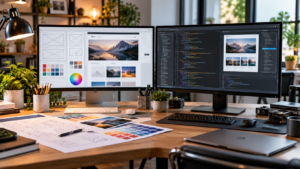
If you are planning a new website or redesign, the simplest way to understand web design vs web development is this: web design determines how the website looks, feels, and guides users, while web development turns that design into a functional website that works across devices, browsers, forms, integrations, and business systems.
Most business website projects need both.
The real question is not whether design or development is more important. It is how much of each your project requires.
Quick Answer: Web Design vs Web Development
| Area | Web Design | Web Development |
| Primary focus | User experience and visual presentation | Functionality and technical implementation |
| Typical work | Layouts, colors, typography, UX, wireframes | Coding, CMS setup, integrations, functionality |
| Main goal | Make the site clear and easy to use | Make the site work reliably |
| Common tools | Figma, Adobe tools, design systems | HTML, CSS, JavaScript, PHP, APIs, CMS platforms |
| Conversion role | Guides users toward actions | Makes forms, checkout, booking, and tracking work |
| SEO role | Supports UX and content hierarchy | Supports speed, crawlability, schema, technical SEO |
| Needed for redesign? | Usually | Often |
| Needed for custom functionality? | Sometimes | Yes |
Bottom line: Design decides what users experience. Development makes that experience technically possible.
What Is Web Design?
Web design focuses on the visitor experience when interacting with a website.
It includes much more than choosing attractive colors or creating a modern-looking homepage.
A web designer may work on:
- Page layouts
- Navigation
- Typography
- Color systems
- Buttons and calls to action
- Wireframes
- User journeys
- Mobile layouts
- Content hierarchy
- Visual consistency
- Accessibility considerations
- Conversion paths
Good business website design answers practical questions.
Can a visitor immediately understand what the company does?
Can they find the right service?
Can they easily contact the business?
Can they use the website comfortably from a phone?
Does the most important information appear in the right order?
Responsive design matters because modern websites must adapt across screen sizes rather than simply shrink a desktop layout.
For businesses planning a new site, professional website design services should therefore consider usability, customer intent, mobile experience, brand presentation, and conversion—not just aesthetics.
What Is Web Development?
Web development is the technical work required to turn designs and business requirements into a working website.
A developer may build:
- Page templates
- Navigation systems
- Contact forms
- Booking systems
- E-commerce functionality
- Product catalogs
- Customer portals
- CRM integrations
- Payment integrations
- APIs
- Search functionality
- Analytics tracking
- Content management systems
- Custom calculators or tools
Development also affects how the website behaves behind the scenes.
That includes:
- Performance
- Security
- Browser compatibility
- Mobile functionality
- Database connections
- Form processing
- Redirects
- Structured data
- Technical SEO
- Hosting configuration
HTML provides structure, CSS controls presentation, and JavaScript can add interactive behavior. Modern development often extends far beyond those fundamentals into CMS platforms, frameworks, APIs, ecommerce systems, databases, and business automation.
Businesses requiring custom functionality, integrations, ecommerce, migrations, or technically complex builds are generally looking for web development services rather than design alone.
What Is the Difference Between Web Design and Web Development?
The main difference between web design and web development is the type of problem each discipline solves.
A designer asks:
What should users see, understand, and do?
A developer asks:
How do we make that experience function correctly?
Imagine a business wants an online appointment system.
The designer determines:
- Where the booking button appears
- How the appointment form looks
- How many steps the user sees
- Which information is requested
- What the confirmation experience looks like
The developer determines:
- How appointment availability is retrieved
- How selections are submitted
- How customer data reaches the CRM
- How confirmation emails are triggered
- How errors are handled
- How the integration works securely
The final customer sees one experience.
Behind that experience are two different disciplines.
Web Development vs Web Design: Which Matters More?
Neither should automatically take priority.
The right balance depends on the business problem.
A beautifully designed site with weak development can have:
- Broken forms
- Slow pages
- Checkout problems
- Poor mobile behavior
- Integration failures
- Tracking errors
- Technical SEO issues
A technically strong site with weak design can have:
- Confusing navigation
- Weak visual hierarchy
- Poor conversion paths
- Inconsistent branding
- Hard-to-read content
- An outdated appearance
- Unclear calls to action
This is why the web development vs web design decision is rarely about choosing one discipline permanently.
It is about identifying what is currently preventing the website from helping the business.
When Does a Business Need Web Design?
Web design should be a priority when the website technically works but creates a weak customer experience.
Common signs include:
The website looks outdated
An older visual style can make an otherwise established company feel less credible than newer competitors.
Visitors struggle to find information
Important services may be buried inside confusing navigation or poorly structured pages.
Mobile usability is weak
Text may be too small, buttons difficult to tap, or layouts awkward on smaller devices.
The site generates traffic but few inquiries
If relevant visitors arrive but rarely call, submit forms, book consultations, or purchase, the problem may involve messaging and user experience.
Branding is inconsistent
Different pages may use unrelated fonts, colors, layouts, or visual styles.
You are repositioning the business
A new audience, service offering, pricing model, or brand direction may require a different website experience.
In these situations, design improvements may create meaningful gains without rebuilding every underlying technical system.
When Does a Business Need Web Development?
Development becomes the priority when the existing website cannot support what the company needs it to do.
Examples include:
You need custom functionality
Such as:
- Customer portals
- Advanced forms
- Booking tools
- Membership systems
- Calculators
- Location finders
- Custom search
- Internal dashboards
Existing tools need to communicate
For example:
Website → CRM → Email Platform → Sales Team
or:
Website → Ecommerce → Inventory → Accounting
These workflows usually require technical implementation.
The website is slow or unstable
Poor code, outdated plugins, hosting issues, and inefficient third-party scripts can create problems that visual redesign alone will not solve.
You are migrating platforms
Moving from one CMS or ecommerce platform to another involves much more than copying the appearance.
Developers may need to manage:
- URLs
- Redirects
- Content
- Products
- Customer records
- Forms
- Analytics
- Integrations
- Tracking
- SEO settings
Your current CMS limits growth
If simple business changes require repeated workarounds or custom patches, the underlying technology may need improvement.
What Does Web Design and Development Include Together?
For many SMB projects, web design and development should be planned as one connected process.
A typical workflow might look like:
- Business discovery
- Audience and competitor research
- Sitemap planning
- Conversion strategy
- Wireframes
- Visual design
- Content preparation
- Development
- CMS configuration
- Integration setup
- Mobile QA
- Accessibility review
- SEO checks
- Analytics implementation
- Launch
- Post-launch testing
This reduces a common problem: designing something that becomes difficult, expensive, or technically impractical to build.
Developers should understand the design direction early.
Designers should understand technical constraints early.
Do You Need Both for a Website Redesign?
Often, yes.
The word redesign can make a project sound purely visual, but many redesigns reveal deeper problems.
For example, imagine a business wants a cleaner homepage.
During the project, the team discovers:
- The site takes five seconds to load
- The WordPress theme is no longer maintained
- Forms are not reaching the CRM
- Mobile layouts break
- Conversion tracking is incomplete
- URLs need restructuring
- Several plugins conflict with each other
At that point, changing the visual design alone would leave the most important problems unresolved.
A redesign should therefore begin with an audit of both:
Front-end experience: What should change for visitors?
Technical foundation: What should change behind the scenes?
How Design and Development Affect SEO
SEO is another area where both disciplines overlap.
Design influences SEO through:
- Navigation
- Content hierarchy
- Mobile usability
- Readability
- Internal linking opportunities
- User experience
- Accessible layouts
Development influences SEO through:
- Crawlability
- Site speed
- Structured data
- Canonicals
- Redirects
- JavaScript implementation
- Mobile rendering
- XML sitemaps
- Core Web Vitals
Accessibility also benefits from coordination between design and development. Semantic HTML provides an important accessibility foundation, while poorly implemented CSS or JavaScript can make otherwise usable interfaces difficult for people using assistive technologies.
That is why SEO, accessibility, UX, and development should ideally be considered before launch instead of being added afterward.
What Does Your Business Actually Need?
Use the following framework.
| Business Situation | Likely Need |
| Website looks outdated but works correctly | Primarily design |
| Navigation and conversion flow are confusing | Design / UX |
| Need a completely new business website | Design + development |
| Need ecommerce functionality | Design + development |
| Need CRM or API integrations | Development |
| Website is slow or technically unstable | Development |
| Rebranding the company | Primarily design, often development |
| Moving to WordPress, Shopify, or another platform | Development + design |
| Adding booking or customer portal functionality | Development |
| Full website redesign with SEO preservation | Design + development |
| Traffic is strong, but conversions are weak | Start with UX/design audit |
| Forms, tracking, or integrations are broken | Development |
Should You Hire a Designer, Developer, or Agency?
The answer depends on scope.
Hire a web designer when:
- The existing technical platform works
- The project is primarily visual
- You need wireframes or UX improvements
- Branding needs improvement
- Developers are already available
Hire a developer when:
- Designs are already complete
- Functionality is the main requirement
- You need integrations
- You have technical issues
- The project involves migration or custom coding
Consider an integrated team when:
- Building a new website
- Completing a major redesign
- Launching ecommerce
- Protecting existing SEO rankings
- Connecting multiple business systems
- Creating a website intended to generate leads
For many SMBs, separating the two disciplines across unrelated providers creates unnecessary coordination problems.
Questions to Ask Before Starting a Website Project
Before hiring anyone, define the outcome.
Ask:
1. Why are we changing the website?
Is the goal:
- More leads?
- Better branding?
- Ecommerce growth?
- Easier content management?
- Better SEO?
- New functionality?
2. What does the current website already do well?
Do not rebuild functioning systems unnecessarily.
3. What specifically is broken?
Separate visual problems from technical problems.
4. Which systems need integration?
List the CRM, payment processor, ecommerce platform, booking software, analytics tools, and marketing systems.
5. How important is organic search?
If SEO already drives traffic, preserving URLs, content, redirects, metadata, and internal links should be part of the project from day one.
6. Who will manage the site after launch?
The answer affects which CMS and development approach make sense.
Common Mistakes Businesses Make
Choosing based only on appearance
A portfolio may look impressive without showing whether the websites are fast, accessible, scalable, or effective at generating business.
Hiring development without planning UX
Developers can build exactly what was requested—but that does not guarantee the requested experience was strategically sound.
Designing without considering implementation
Highly complex animations and interactions may increase development cost without improving business outcomes.
Ignoring mobile users
Responsive web design is a core part of modern website delivery, not an optional finishing touch.
Treating SEO as a post-launch task
Redesigns can damage established rankings when URLs, content, internal links, or technical signals change without a migration plan.
Web Design vs Web Development: Final Decision Checklist
Choose web design first if your biggest problems are:
- Appearance
- User experience
- Navigation
- Branding
- Page hierarchy
- Conversion flow
Choose web development first if your biggest problems are:
- Functionality
- Performance
- Integrations
- Custom systems
- Platform limitations
- Technical errors
Choose both if you are:
- Building a new website
- Completing a major redesign
- Migrating platforms
- Launching ecommerce
- Creating custom functionality
- Reworking both UX and technology
For most growing businesses, design and development work best when they support the same business objective rather than operating as separate projects.
Frequently Asked Questions
What is the main difference between web design and web development?
Web design focuses primarily on visual presentation, user experience, layouts, and how visitors interact with the site. Web development focuses on building the website technically and making its functionality, integrations, forms, databases, and systems work correctly.
Is web design the same as web development?
No. They are related disciplines but serve different purposes. Designers plan the experience and interface, while developers implement the technical functionality required to make the website operate.
Does my business need a web designer or web developer?
If the main problem involves branding, appearance, navigation, or user experience, start with design. If the issue involves functionality, integrations, performance, or technical limitations, development is usually the priority. New websites and major redesigns generally require both.
Can a web developer also design a website?
Some professionals work across both disciplines, but expertise varies. A developer may understand visual design, and a designer may understand code, but complex projects often benefit from specialists working together.
Do website redesign projects require development?
Not always, but many do. If the redesign changes templates, CMS functionality, integrations, page architecture, mobile behavior, forms, or technical SEO, development work will normally be required.
Final Thoughts
Understanding web design vs web development makes it easier to budget correctly, hire the right team, and avoid solving the wrong problem. Design shapes how customers experience the website; development determines how reliably and effectively that experience works.
For SMBs building a new website or planning a major redesign, the strongest approach is usually to connect both disciplines from the beginning. Do Better Inc. provides website design and web development support for businesses that need a website built around usability, performance, search visibility, conversion goals, and long-term growth.