If you need customers this month, start with Google Ads. If you can wait a few months and want leads that keep coming after the budget stops, start with SEO. Most small businesses end up needing both, so the real question in the Google Ads vs SEO debate is which one gets your first dollar. This guide gives you a way to decide using your own numbers: how fast you need leads, what a customer is worth to you, and how crowded your market is.
We run both channels at Do Better, so we have a bias toward using them together. We will say where each one is the wrong first move, because that is the part most comparison posts skip.
The short answer
Pick Google Ads first when speed matters more than cost per lead, when one new customer is worth a lot, or when you have a new site with no search visibility yet. Pick SEO first when your budget is tight but your timeline is flexible, when clicks in your industry cost more than a click is worth, or when people research for weeks before they buy.
Neither is “better” in general. They solve different problems at different speeds, and the right mix changes as the business grows.
How Google Ads works
Google Ads is paid placement. You bid on search terms, write ads, and Google shows them when someone searches. On the standard search campaigns, you are billed per click. You set a maximum you will pay per click, and Google’s own help page notes the actual charge is often lower (Google Ads Help).
You also set an average daily budget. On busy days Google can spend up to about twice that amount, but over a month your charges should not go above your daily budget multiplied by 30.4 (the average days in a month). So you control the ceiling, even if single days bounce around.
The catch is simple. When you pause a campaign or the budget runs out, the ads stop showing. Paid traffic is rented traffic.
What about Local Services Ads?
If you run a service business, there is a variation worth knowing about. Local Services Ads work on a pay-per-lead model instead of pay-per-click, so you are charged when you receive a lead, not when someone clicks. Google recommends a weekly budget that supports at least 10 leads, and says to expect about two weeks while the system learns your business (Google Local Services Ads Help). If that sounds like your business, our Google Local Services Ads management page explains how we set them up.
How SEO works
SEO is the work of earning a place in the organic results, the listings below the ads. You do it through useful pages, a technically healthy site, clear signals about what you do and where, and links from other sites that vouch for you. For a local business it also includes your Google Business Profile and local rankings, which our guide on how to improve local SEO rankings covers in detail.
You do not pay Google for any of it. Google says organic results are based on the search itself and are not affected by whether a business buys ads, and that nobody can pay to change how a site ranks (How Google Search works). What you pay for is the work: writing, development, outreach and the time to do them properly.
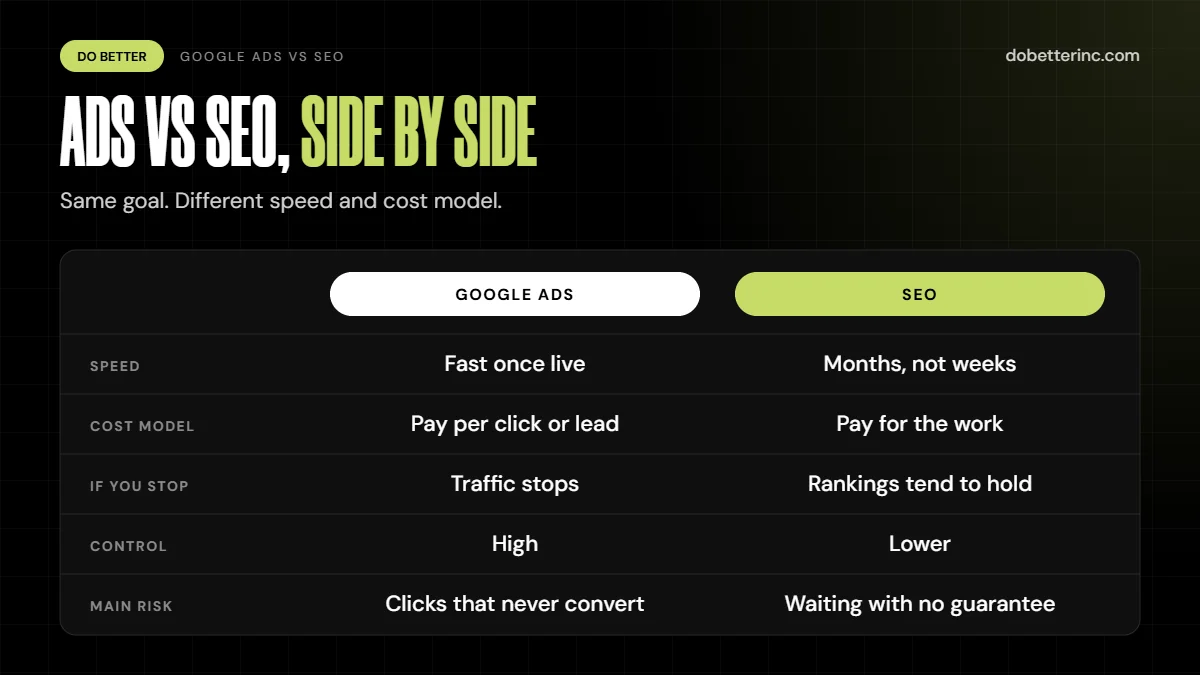
Google Ads vs SEO side by side
| Factor | Google Ads | SEO |
|---|---|---|
| Speed to first leads | Fast once campaigns are live and learning | Slower; months, not weeks |
| Cost model | Pay per click (or per lead for Local Services Ads) | Pay for the work, not per visitor |
| When you stop paying | Traffic stops | Rankings tend to hold for a while, but need upkeep |
| Control | High: budget, keywords, location, schedule | Lower: Google decides rankings |
| Who clicks | People ready to act on commercial searches | A mix, depending on which pages rank |
| What scales it | More budget | More good pages, authority and time |
| Main risk | Paying for clicks that never become customers | Waiting months with no guarantee |
| Feedback speed | Data from the first week | Slower and noisier |
What each one really costs (and how to do the math)
We will not give you a price range here, because it depends on your city, your industry and how aggressive competitors are. If you want to see how local pricing varies for SEO, our SEO cost by city guide breaks that down. What you can do today is run the same simple math on both channels.
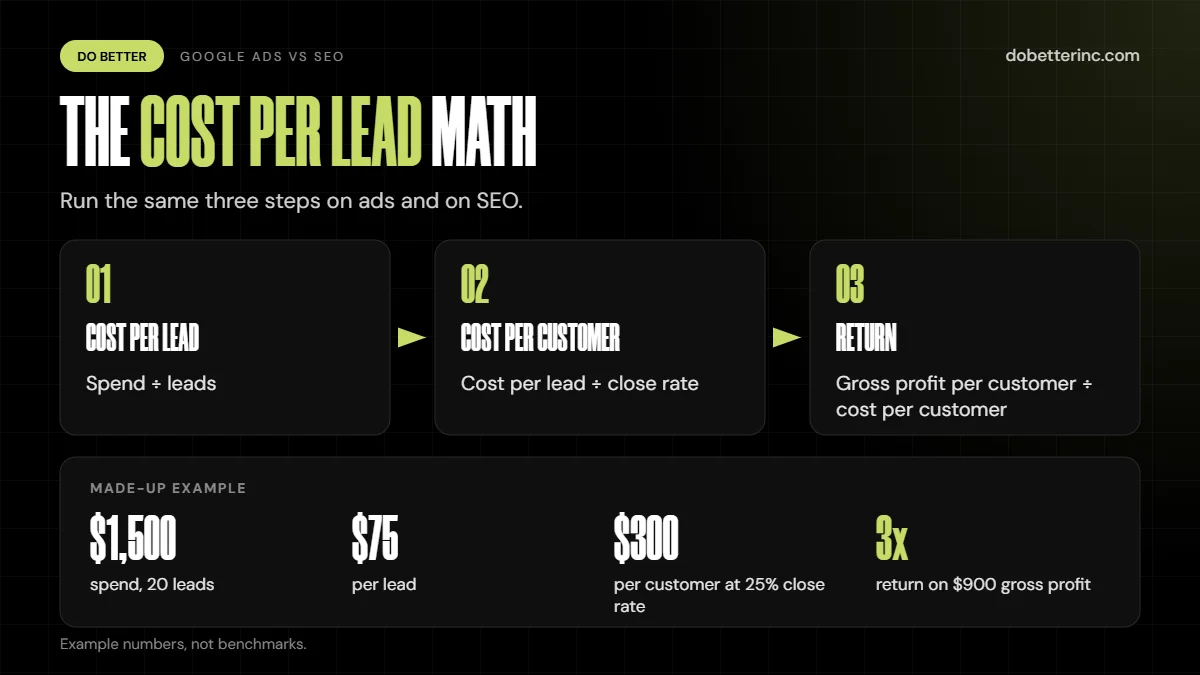
- Cost per lead = what you spent ÷ leads you got.
- Cost per customer = cost per lead ÷ the share of leads that become customers.
- Return = gross profit per customer ÷ cost per customer.
Here is a made-up example, so you can see the mechanics. These are not benchmarks.
Say you spend $1,500 in a month on ads and get 20 leads. That is $75 per lead. If one in four leads books a job, you are paying $300 per customer. If the average job leaves you $900 in gross profit, each customer returns three times what it cost to win. Ads work in that case, and you can scale by adding budget until the numbers stop holding.
SEO runs a deficit first. Say you pay $1,500 a month and meaningful leads take five months to show up. You have put in $7,500 before the first result, and nothing guarantees the timeline. If the leads then keep arriving month after month at the same retainer, the cost per lead falls over time. If they do not, you overpaid. That is the trade: SEO has a worse start and, when it works, a better long run.
Before you run any numbers, make sure you can count leads at all. Phone calls, form fills and booked appointments all need tracking, or the math is guesswork. Our analytics and reporting service exists mostly for that reason.
How long each one takes
Ads are quick, but not instant. You need account setup, ad copy, a landing page that fits the search, and a week or two of data before the numbers settle. Google’s own guidance for Local Services Ads is about two weeks.
SEO has no honest timeline. Google’s SEO Starter Guide says some changes might take effect in a few hours, while others could take several months (Google Search Central). Anyone who promises a ranking date is guessing. A reasonable plan is to think in months, and to judge early progress by leading signs: more pages indexed, more impressions in Search Console, rankings creeping up for target terms, before you judge by leads.
When Google Ads should come first
- You need leads within weeks. A slow month, a new location, or cash flow pressure all point here.
- One customer is worth a lot. If a single job covers many clicks, paid search can pay for itself fast.
- Your site is new. A site with no history will not rank for competitive terms soon, and ads can send visitors while the site builds credibility.
- You want to test demand. Ads tell you which searches turn into inquiries before you commit months to writing for them.
- The business is time-sensitive. Seasonal work, a promotion or an event does not wait for rankings.
- You are an urgent-need service. People searching for an emergency repair often click the first option that looks trustworthy.
When SEO should come first
- The budget is tight and the timeline is flexible. If you can pay for the work now and wait for results, SEO can be the better use of limited money.
- Clicks cost more than a click is worth. If the math from the section above says each ad click is too expensive for your margins, organic traffic is the way around it.
- Customers research before they buy. Long sales cycles favor businesses that show up repeatedly in organic results and in helpful articles.
- You already have a decent site. If you sit on page two for good terms, targeted improvements can move the needle without a huge spend. Our guide on why a website is not ranking on Google helps diagnose that.
- You want an asset. Pages that rank keep working after you finish paying the person who built them.
Why most small businesses end up running both
The two channels help each other more than people expect.
- Ads show you which searches lead to real inquiries, so you know which topics deserve SEO effort.
- Ads cover the months while SEO builds.
- Strong organic pages lower how much you depend on paid clicks over time.
- Showing up in both the ad and the organic listing on the same results page gives you more space and more trust.
- Visitors who found you through SEO can be reached again with ads if they left without contacting you.
A common pattern is to start ads in month one, build the SEO foundation in parallel (site fixes, key pages, Google Business Profile), and review every quarter to see whether the mix should shift. For a local business, a complete Google Business Profile is part of that foundation and costs nothing to start.
Does Google Ads help your SEO?
Not directly. Google says that buying ads does not change how organic results rank, and a Google search advocate, John Mueller, said in 2021 that running or removing ads has no effect on organic rankings because the two systems are separate (Search Engine Roundtable).
The indirect benefits are real, though. Ad data tells you which keywords convert, and ad traffic can show you which pages persuade people. Use ads to learn, not to expect a ranking boost.
Mistakes we see most often
- Choosing based on what is trendy. The right pick depends on your margins and timeline, not on what another business says worked for them.
- Running either channel without tracking. If you cannot tell a phone call from a form fill from a wrong number, you cannot judge anything.
- Judging SEO after six weeks. Early signs matter, but leads usually come later.
- Sending all ad clicks to the home page. A page that matches the search converts better than a general landing spot.
- Letting ads run on autopilot. Search terms drift. Review them regularly and add negative keywords so you stop paying for irrelevant clicks.
How to decide in 15 minutes
Answer these five questions honestly, then use the table.
- How soon do you need new customers?
- What is one customer worth in gross profit?
- Can you track calls, forms and bookings today?
- Does your site already rank for anything useful?
- How much can you spend each month for at least six months without stress?
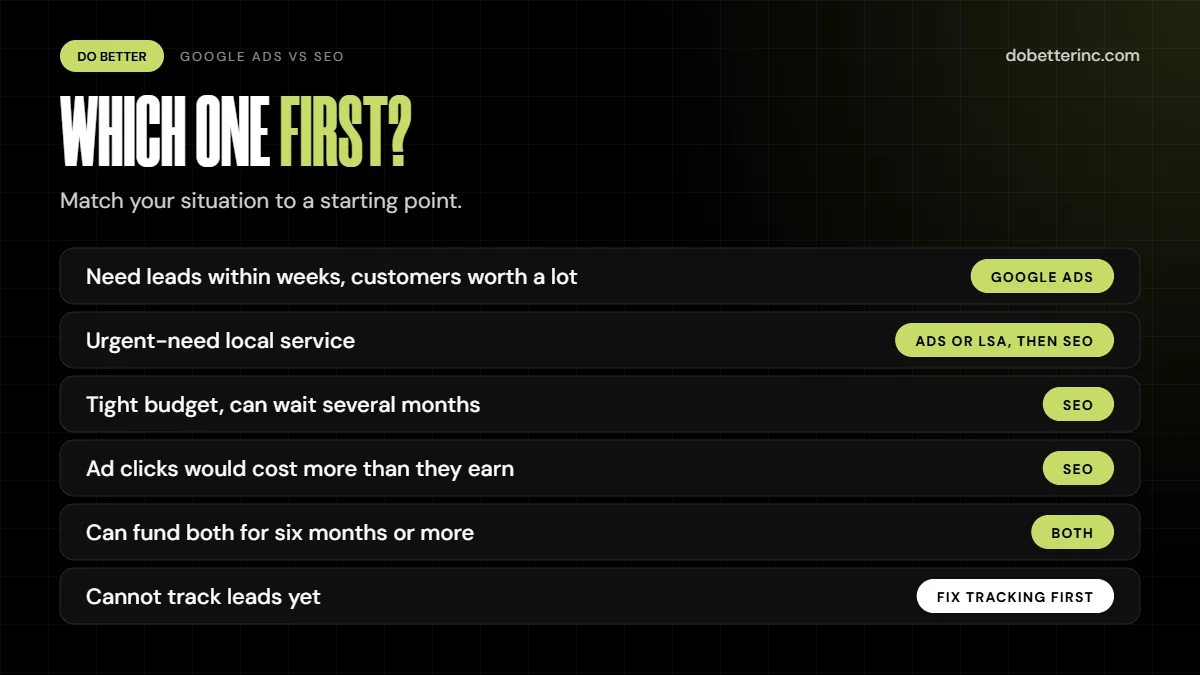
| If this is true | Start with |
|---|---|
| You need leads within weeks and a customer is worth a lot | Google Ads |
| You are a local service business with urgent-need customers | Google Ads or Local Services Ads, then add SEO |
| Budget is limited and you can wait several months | SEO |
| Ad clicks in your industry would cost more than they earn | SEO |
| You can fund both for six months or more | Both, with ads covering the early months |
| You cannot track leads yet | Fix tracking first, then pick |
If you are unsure, a search performance audit will show you where your site stands before you spend on either channel.
FAQ
Is Google Ads or SEO better for a small business?
Neither wins in every case. Google Ads is better when you need leads quickly or each customer is worth a lot. SEO is better when you can wait and want leads that continue after you stop paying for the work. Many small businesses use both, with ads covering the early months while SEO builds.
Which is faster, Google Ads or SEO?
Google Ads is faster. Campaigns can generate leads within days to a couple of weeks once they are set up and learning. Google says SEO changes can take anywhere from a few hours to several months to show an effect, so plan on months.
Is SEO cheaper than Google Ads in the long run?
It can be, but it is not guaranteed. SEO costs more upfront in waiting time with no return, then often costs less per lead if rankings hold and grow. Ads cost the same per click as long as you run them, so the cost per lead tends to stay flat or rise with competition. Run the cost-per-customer math on your own numbers before deciding.
Can I run Google Ads and SEO at the same time?
Yes, and for many businesses it is the best plan. Ads bring in leads while SEO builds, ad data shows which keywords convert, and strong organic pages reduce how much you rely on paid clicks over time.
Does running Google Ads improve my organic rankings?
No. Google states that buying ads does not affect how organic results rank, and Google’s John Mueller said the same in 2021. Ads can still help indirectly by showing you which searches and pages convert.
How should a small business split its budget between Google Ads and SEO?
There is no standard split. Start by working out what a customer is worth and how many leads you need. If you need leads fast, put more toward ads at first and fund a smaller SEO foundation alongside. If you have time, reverse it. Review the split every quarter using real lead and customer numbers.
Not sure which one to start with?
If you would rather have a second opinion than guess, we can look at your current ads, your search visibility and your lead tracking, then tell you where the first dollar should go. Do Better runs Google Ads management and SEO in Las Vegas under one roof, so the advice is not tilted toward one channel. If you are still choosing a partner, our piece on how to choose the right SEO agency lists the questions worth asking. You can contact us with your site and your goals.